Student wins Prime Minister’s Future Scientist Prize for a road-safety app
MEDIA RELEASE: TE PUIAKI KAIPŪTAIAO ĀNAMATA FUTURE SCIENTIST PRIZE
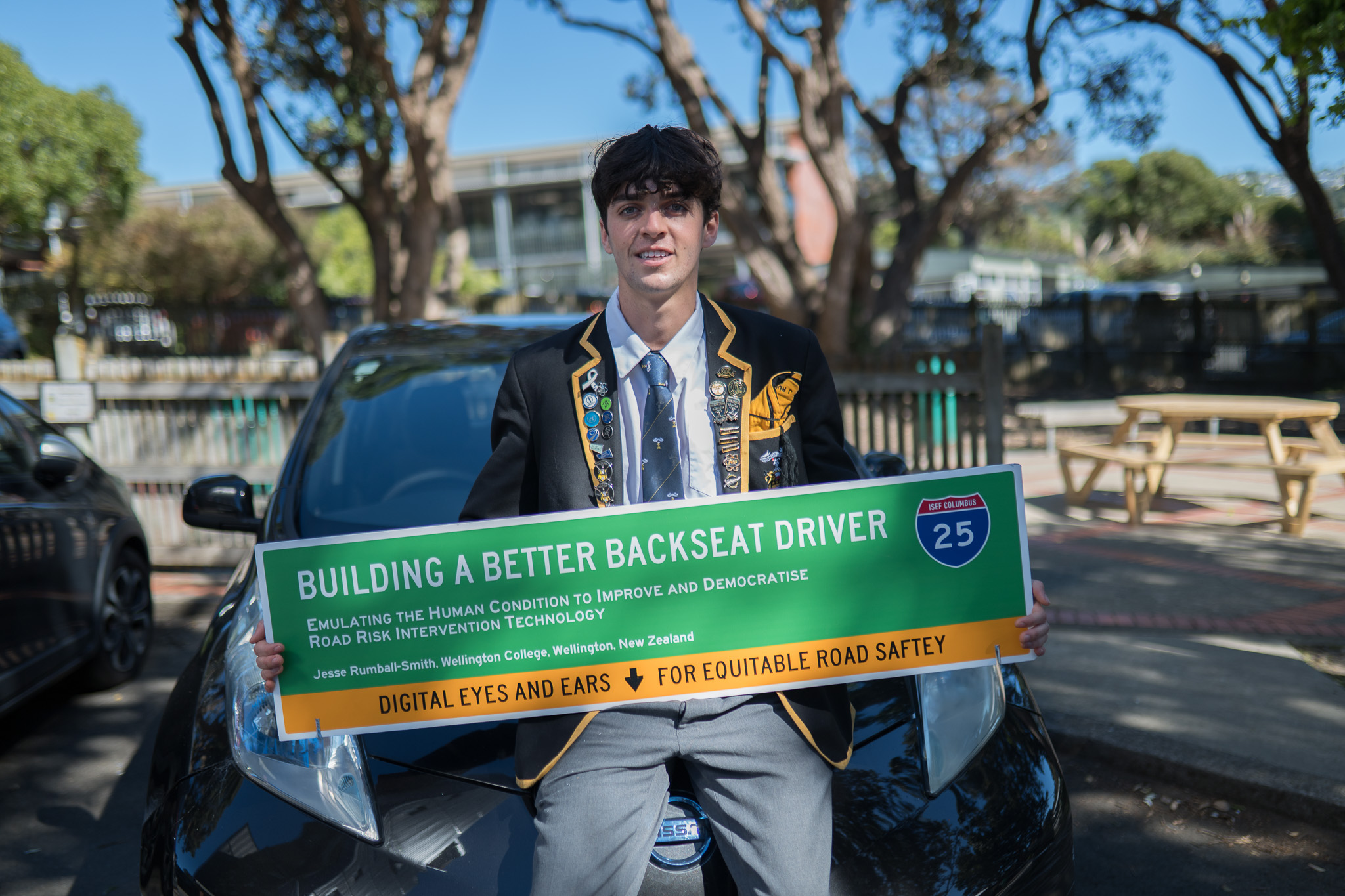
The Prime Minister’s Future Scientist Prize, for an innovative project by a secondary school student, was awarded to Jesse Rumball-Smith from Wellington College.
Jesse designed a smartphone app to bring the advanced safety features of newer vehicles to all drivers, by using the “supercomputer in everybody’s pockets”.
The motivation for his research was to address inequity in road safety and to reduce fatalities.
Advanced features in new cars, like intelligent speed assistance, can reduce harm, but people in ageing vehicles are least likely to benefit.
Jesse was concerned that the drivers of older cars, who were predominantly on lower incomes, were dying disproportionately on our roads.
“50% of our fleet is older than 13 years,” he says. “They only travel 40% of the total distance travelled on New Zealand roads, and yet those old cars make up a disproportionate 65% of the crashes.”
“To address this, I built an app that combines behavioural psychology to know how to tell you to slow down, and AI and computer vision to understand the road environment in order to predict your risk.”
Jesse says it took about 3 years to develop his app “Better Backseat Driver”.
“It began with a focus on communication, researching the best way to tell a driver to slow down or take a break.”
The app scans both the external environment and internal factors affecting safety, such as the driver’s level of alertness.
“The most recent years of research was about giving the phone in your pocket digital eyes to understand the road environment.”
He says his app has been tested against industry-standard databases to validate its skills at perception and communication.
Jesse has tested his app in three cities, using more than 30 drivers who together covered over 500km.
He says there are “a lot of cool next steps for the project”, both in developing the technology, and in making it available to more people.
“We’ve got digital eyes, we can see the road. But what about digital ears? In terms of developing the technology further, it’s that continual process of trying to replicate how you, as a human being, understand the road.”
Jesse explains that his technology could be used outside of use in private cars: “It can be used in commercial vehicles, by telematics providers to insurance companies and being able to prove that you’re a safe driver. Even aerospace and pilots – it’s important to know if you’re tired on the job and the tech I’ve developed will be able to tell if you’re fatigued”.
On winning the Prize, Jesse says it’s an acknowledgment of 3 years of late nights, “but also of the importance of continuing to solve problems”.
“The real importance of science, for me at least, is to improve the world around us and improve the lives of the people that live in it.”
“There’s the whakataukī: ‘Te aha te mea nui o te ao? He tāngata, he tāngata, he tāngata. What is the most important thing in the world? It is people, it is people, it is people’.”
“That’s most definitely true for this project and for the way I view science as a whole: to benefit the people in those older cars on the road,” Jesse says.
“We do not need to wait for our fleet to turn over to these new fancy cars with all these safety features. With a bit of innovation, a bit of behavioural psychology, and the supercomputer in everybody’s pockets, we can all be safe on our roads.”
In recommending Jesse for this Prize, the expert panel noted that he is already thinking like a scientist.
“He surveyed the literature, including psychology, to achieve real-time object detection, depth estimation, and fatigue analysis on standard devices”.
Last year, Jesse was selected by the Royal Society Te Apārangi to represent Aotearoa New Zealand at the International Science and Engineering Fair in the United States of America. He presented an earlier iteration of this project, and won first place in the Behavioural and Social Sciences category.
This year, Jesse was selected to represent us again, for a different project, titled Wool that Breathes, which involved development of a woollen textile that could capture carbon dioxide passively.
Jesse is currently gaining work experience at Rocket Lab and will travel to the USA shortly to begin undergraduate studies at Harvard University.